
Why an HVAC Pathway Fits the Children of Veterans
Growing up in a military household often means learning resilience, discipline, and teamwork by example. Those same qualities translate powerfully into the skilled trades—especially into HVAC (heating, ventilation, and air conditioning). An HVAC course for veteran children leverages that background, offering a clear pathway into essential, well‑paid, and meaningful work that keeps families comfortable and businesses productive. It aligns with the mission‑driven mindset so familiar to veteran families: diagnose the problem, execute the plan, and deliver results that impact people’s lives in a tangible way.
HVAC is a field where hands and head work together. Every day blends technical problem‑solving with real‑world action, whether installing a high‑efficiency heat pump, optimizing airflow for a multi‑zone home, or fine‑tuning refrigerant charge for peak performance. For veteran children who appreciate structure and purpose, the routine of service calls, safety checklists, and quality verification provides a satisfying rhythm. The profession also offers stable demand across the country—homes, schools, clinics, and bases rely on HVAC systems year‑round—so graduates can carry their skills wherever life takes them.
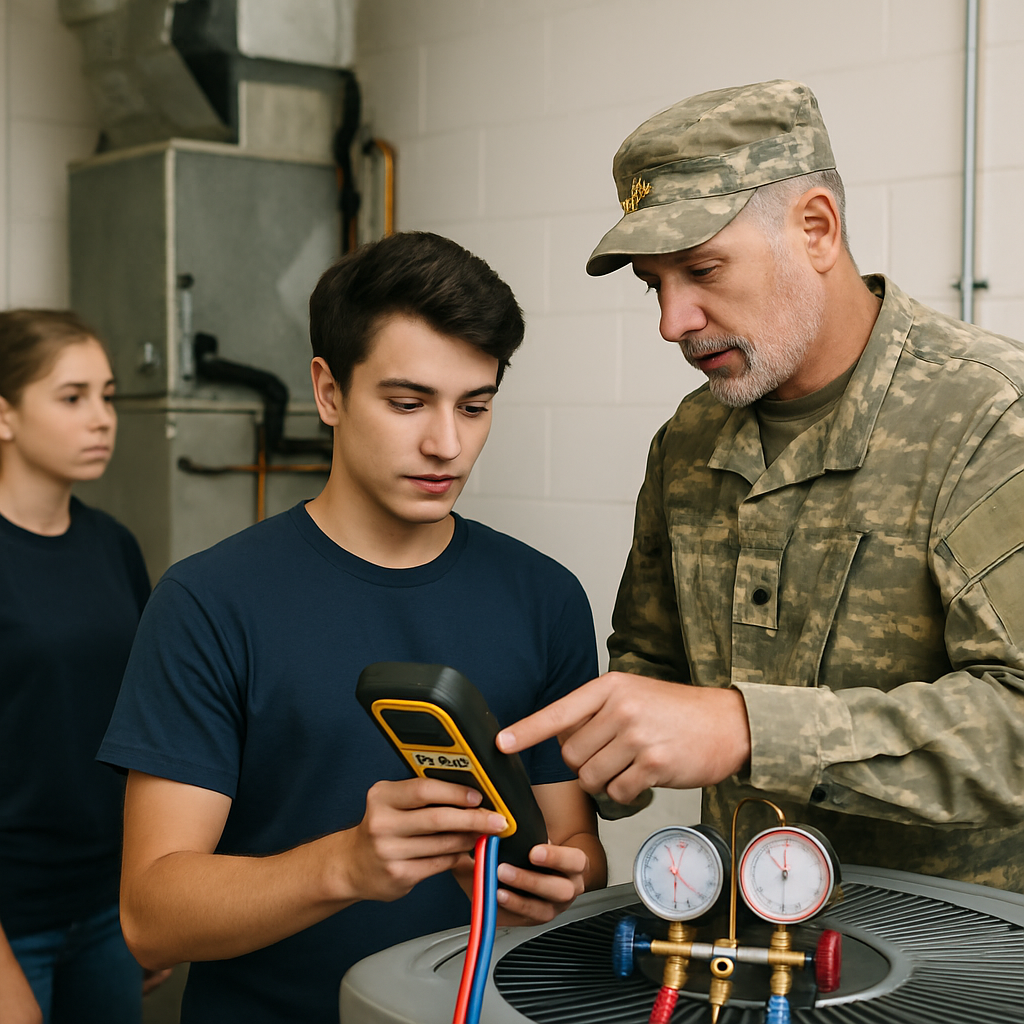
In a high‑caliber program, practical training anchors the learning experience. Students don’t just memorize diagrams; they practice pressure readings, wire control circuits, and balance duct systems until those tasks feel second nature. They study design principles to understand why a system succeeds or fails. They learn to communicate findings clearly to homeowners and facility managers. This combination of field‑ready technique and strong communication prepares graduates to step into entry‑level roles with confidence.
For added relevance, the curriculum speaks to modern technologies. As communities push for energy efficiency and smarter comfort control, technicians who understand heat pumps, zoning, advanced airflow diagnostics, and accurate refrigerant charging are especially valuable. Quality installation—not just quick fixes—becomes the hallmark of a trusted professional. If this direction resonates, explore the HVAC course for veteran children that blends hands‑on labs with accessible online study, designed to turn interest into a career‑ready skill set.
What a Purpose-Built HVAC Curriculum Includes
A strong HVAC training path for veteran children starts with fundamentals and moves steadily into real‑equipment practice. The first building block is safety: electrical lockout/tagout, proper tool handling, personal protective equipment, and environmental stewardship. That foundation supports every lab and field scenario that follows. From there, students study thermodynamics in plain language—temperature, pressure, and phase change—so they can predict system behavior before they even open a panel.
System design and installation quality take center stage next. Learners map out duct runs, calculate loads, select equipment, and size components to match real‑world homes and light commercial spaces. They examine the consequences of undersized returns or oversized equipment: noise, short cycling, uneven temperatures, and early failures. With that context, airflow testing becomes more than a number; it becomes the guiding metric of comfort and reliability. Students measure total external static pressure, set blower speeds, and confirm that design and performance actually match.
Hands‑on labs reinforce every concept. In a typical session, students might wire low‑voltage controls, commission a heat pump in both heating and cooling modes, and verify the defrost cycle under simulated winter conditions. They practice zoning strategies by installing dampers and controllers, then monitor how airflow and temperature respond in each zone. During refrigerant labs, they learn charging methods and superheat/subcooling calculations for fixed or TXV metering devices, always linking the math to the system’s behavior at the registers. Furnace fundamentals rounds out the core: combustion air, venting, flame rectification, and sequence of operation for safe, consistent heating.
Equally important are soft skills and diagnostics. Students follow a step‑by‑step troubleshooting tree: gather the history, verify the complaint, test, isolate, and confirm. They practice explaining options and outcomes in everyday language, earning trust by showing data and results rather than guesswork. Blended learning—combining in‑person labs with online modules—helps each learner progress at a sustainable pace. Short videos, knowledge checks, and interactive simulations prepare learners before they ever connect gauges in the lab. By the end, graduates can perform quality installations, tune existing systems, and document their work in a way that makes both customers and supervisors confident in the results.
Getting Ready for Class: Schedules, Support, and Real-World Scenarios
For many veteran children, life includes part‑time jobs, family responsibilities, or college credits. A practical HVAC course acknowledges that reality with flexible schedules and blended delivery. Weeknight or weekend labs accommodate busy calendars, while online theory lessons keep momentum between sessions. The result is consistent progress without sacrificing work or family time. Small cohorts and clear milestones ensure learners know exactly what to expect each week: safety checks, hands‑on lab objectives, and performance targets that build skill step by step.
Support structures make a critical difference. Mentors—often instructors with field experience—offer feedback on technique, from brazing posture to meter setup. Peer learning accelerates growth too; students practice explaining a diagnostic path to each other, the same way they’ll do with homeowners or site managers. Career guidance sessions help translate new skills into next steps: assembling a resume that highlights lab competencies, practicing interviews that emphasize safety, accuracy, and customer care, and understanding how entry‑level roles evolve into lead installer, service specialist, or system designer. The emphasis is on career‑ready ability: show up prepared, complete the task safely, verify performance, and document results.
Real‑world scenarios bring the curriculum to life. In one lab case, a home’s back bedrooms never cool down. Students measure total external static pressure, discover a restrictive return path, and propose a duct modification plus blower adjustment. They then validate the fix with improved pressure and temperature readings—an exercise in data‑driven comfort. In another scenario, a cold‑climate heat pump appears underperforming. Learners confirm charge via superheat/subcooling, inspect outdoor coil condition, verify sensor inputs for defrost timing, and check auxiliary heat staging. They communicate findings clearly, outlining both immediate remedies and preventive maintenance steps.
Service culture also matters. Many who grew up in military homes understand punctuality, accountability, and respect—traits customers notice. A training path designed for veteran children builds on those strengths, weaving them into every lab and role‑play. When a homeowner worries about rising bills, students learn to present options grounded in quality installation and verification: airflow correction, refrigerant tuning, duct sealing, smart controls, or equipment right‑sizing. In climates with extreme summers or winters, this approach minimizes callbacks and maximizes comfort. The message is consistent: master the fundamentals, measure what matters, and take pride in delivering systems that perform as promised. That mindset—shaped at home and refined in the lab—becomes the signature of a professional who serves with skill and integrity.

Seattle UX researcher now documenting Arctic climate change from Tromsø. Val reviews VR meditation apps, aurora-photography gear, and coffee-bean genetics. She ice-swims for fun and knits wifi-enabled mittens to monitor hand warmth.