
Why AI Jewellery Product Photography Is Reshaping Visual Production
Jewellery is among the most challenging categories to photograph. Tiny prongs, mirror-like metals, and refractive gemstones amplify every specular highlight, dust particle, and lens inconsistency. Traditional studio shoots demand specialized rigs, polarizing filters, exhaustive lighting tests, and painstaking retouching—often repeated for each variant, size, and metal finish. AI jewellery product photography changes the equation by bringing physics-aware rendering, material intelligence, and automated retouching into a streamlined, on-demand pipeline that turns assets into sales-ready imagery at scale.
Instead of organizing a full studio day for every collection drop, brands can upload CAD files, sketches, or even refined product photos and generate consistent packshots, lifestyle scenes, and on-model visuals in 2K or 4K. Neural rendering models simulate metal roughness and polish, gemstone dispersion and scintillation, and the nuanced behavior of shadows on curved, high-gloss surfaces. Smart segmentation identifies bezels, pavé, prongs, and claws, isolating each element for precise lighting, color, and reflection control without manually masking. The result is studio-quality output that aligns to your style guidelines—consistent angles, repeatable lighting families, and reliable color management—delivered in hours rather than weeks.
For growing design houses and independent artisans, this means the ability to preview and merchandise collections before physical samples are complete. With a drag-and-drop studio and pre-set lighting recipes, it’s easy to produce a coherent visual system for your e‑commerce catalog and social campaigns. You can map materials (18k yellow gold, rhodium-plated silver, platinum), set gemstone libraries (emerald, ruby, sapphire, diamond), and output every variant—metal, stone, and size—without rebuilding your scene. That’s a breakthrough for brands with deep SKU trees or made-to-order models.
There’s also a strategic upside: speed-to-creative. Launches no longer hinge on booking talent, sourcing props, or shipping samples across cities. With AI-driven relighting and background generation, you can produce white-background packshots for marketplaces alongside lifestyle images that match brand campaigns and seasonal stories. When priorities shift, a single prompt or scene tweak can instantly roll out a new look, keeping editorial and e‑commerce aligned. Explore more about AI jewellery product photography to see how brands are standardizing quality while accelerating production.
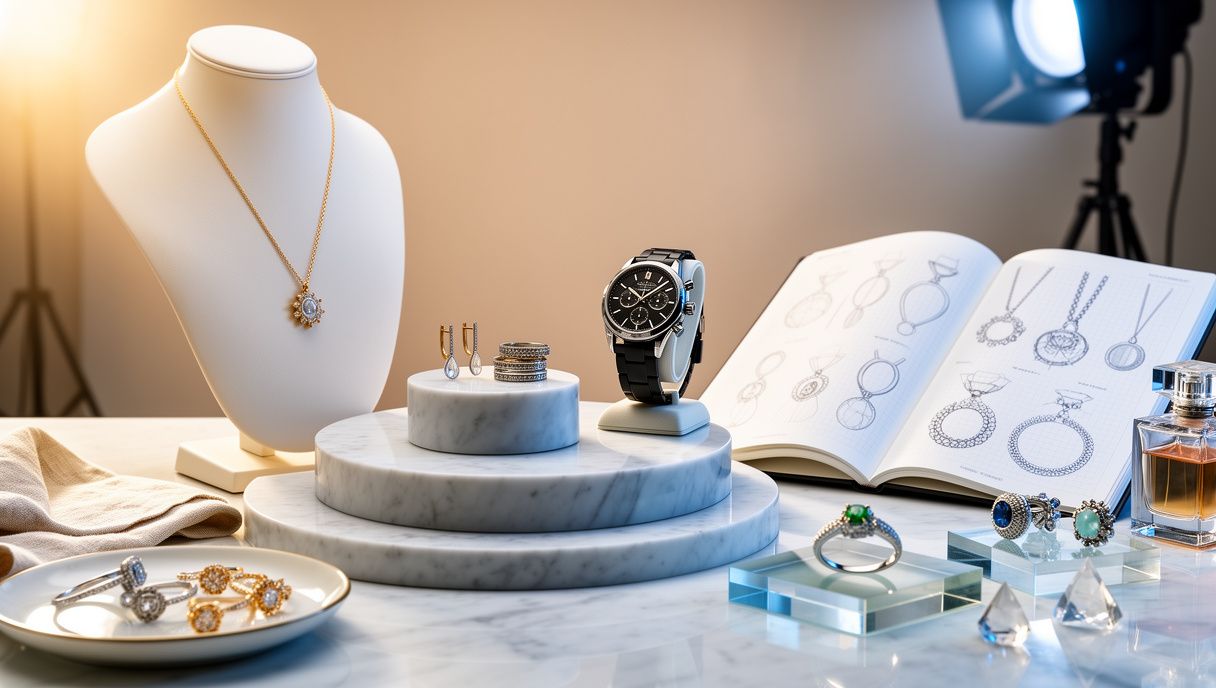
How to Build a High-Fidelity AI Workflow for Jewellery: Assets, Lighting, and Quality Control
The best outputs start with strong inputs. If working from CAD, prepare watertight models with realistic edge chamfers—ultra-sharp edges can look computer-generated, while subtle bevels catch light naturally. Assign physically correct materials: gold with appropriate roughness and color values, rhodium for white metals, and high-quality index-of-refraction settings for gemstones. If starting from photos, capture a clean reference with controlled white balance; AI can relight and rebuild but still benefits from neutral, properly exposed inputs.
Next, define your lighting strategy. Jewellery thrives on structured gradients. Consider a soft, wraparound key light to draw metal curves, a controlled rim light to articulate edges, and modest fill to avoid flatness. For glossy finishes, add large, soft reflections that imply a studio environment without blowing out highlights. In lifestyle scenes, keep lighting logical—if the hero light is left-biased, ensure shadows, reflections, and environmental cues agree. AI relighting tools can harmonize these elements, but a deliberate base look creates authenticity and repeatability.
Build a scene “system” for scale. Start with a master view per product family—earrings, pendants, rings, bracelets, watches—then lock angle, distance, and focal length to standardize output. Configure a set of on-model imagery looks (hand, neck, ear, wrist) with diverse skin tones, posing, and wardrobe styling that complements metal hue and gemstone color. Use prop minimalism: velvet blocks, acrylic risers, or stone slabs can hint at texture and value without competing for attention. AI can vary materials and backgrounds quickly, but keep brand guardrails—palette, mood, and negative space—consistent across SKUs.
Quality control is non-negotiable. Zoom to 100–200% to inspect prong alignment, bezel symmetry, claw thickness, facet crispness, and hallmark legibility. Metals should show clean, believable reflections—no stair-stepped gradients or plastic-like shine. Diamonds need controlled fire and brilliance; colored stones should reveal internal life without artificial glow. Check micro-shadows under prongs and between links to sell depth. Color-manage exports to sRGB for web while retaining high-resolution masters for print or high-DPI placements. Deliver in standardized crops (e.g., 1:1, 4:5, 16:9) with ample negative space to accommodate overlays and responsive layouts.
Finally, integrate SEO and accessibility. Name files with structured keywords: brand, product, metal, stone, and angle. Write alt text that is descriptive and human-friendly: “18k yellow gold solitaire engagement ring with round brilliant diamond on white background.” Maintain consistent AI jewellery product photography terminology across metadata, while avoiding keyword stuffing. The goal is to ensure images are discoverable and accurately represented in search and marketplaces.
Use Cases, Scenarios, and ROI: Turning Creative Agility into Growth
The clearest win is catalog velocity. Imagine a boutique jeweller introducing a ring in three metals and four stones, each with three angles and an on-model view. That’s at least 36 images—before adding lifestyle scenes or seasonal colorways. With AI-driven workflows, these variations can be produced from a single master scene or CAD with consistent framing and lighting, keeping the entire collection coherent. This consistency strengthens brand identity and reduces cognitive load for shoppers, lifting conversion and lowering returns caused by visual mismatch.
Pre-launch merchandising is another powerful scenario. Designers can generate photorealistic visuals before prototypes are finished, enabling wholesale previews, lookbook creation, and DTC waitlist campaigns. A London independent might drop a capsule collection online the same week it’s finalized in CAD, using lifelike renders and on-model imagery to test price points and gather customer feedback. Meanwhile, a New York watch startup could seed social teasers—hero dial close-ups, crown macro details, and bracelet texture—weeks ahead of hardware delivery. Faster feedback loops reduce risk and help teams allocate inventory more intelligently.
Editorial and paid media benefit from the same agility. Create cohesive lifestyle campaigns that localize scenes for different markets: a minimalist studio in Copenhagen-inspired hues for EU audiences, warm, sunlit setups for Southern Hemisphere summer, moodier marble backdrops for luxury marketplaces. AI relighting and background control keep metal tones and gemstones accurate while aligning each asset to regional tastes, holidays, or retail partner specs. Need 4K hero stills for OOH or print? Upscale from the master scene without reshooting, preserving consistency across channels.
There’s also an operational advantage in long-tail content. Customer service needs zoomed technical shots showing clasp mechanics or earring backs; marketplaces require clean white-background frames; social teams want behind-the-scenes vibes; email teams need cropped detail macros for mobile. A flexible AI pipeline outputs all of these without juggling studio bookings, retouchers, and re-briefs. Teams can iterate quickly, A/B test image sequences, and adapt to trend cycles while keeping craftsmanship front and center.
Cost and sustainability play a role too. Reducing reshoots, couriering samples, and prop waste lowers overhead and carbon footprint. For artisans and small brands, this levels the playing field with larger houses—quality becomes a function of taste and direction, not just budget. And because AI jewellery product photography standardizes technique, even expanding teams can maintain a recognizable visual signature: the same angle for a solitaire ring shot, the same luminous gradients for hoops, the same editorial aesthetic across stone families. Over time, the library becomes an asset in itself—your brand’s living, adaptable visual system, engineered for retail realities and creative ambitions alike.

Seattle UX researcher now documenting Arctic climate change from Tromsø. Val reviews VR meditation apps, aurora-photography gear, and coffee-bean genetics. She ice-swims for fun and knits wifi-enabled mittens to monitor hand warmth.